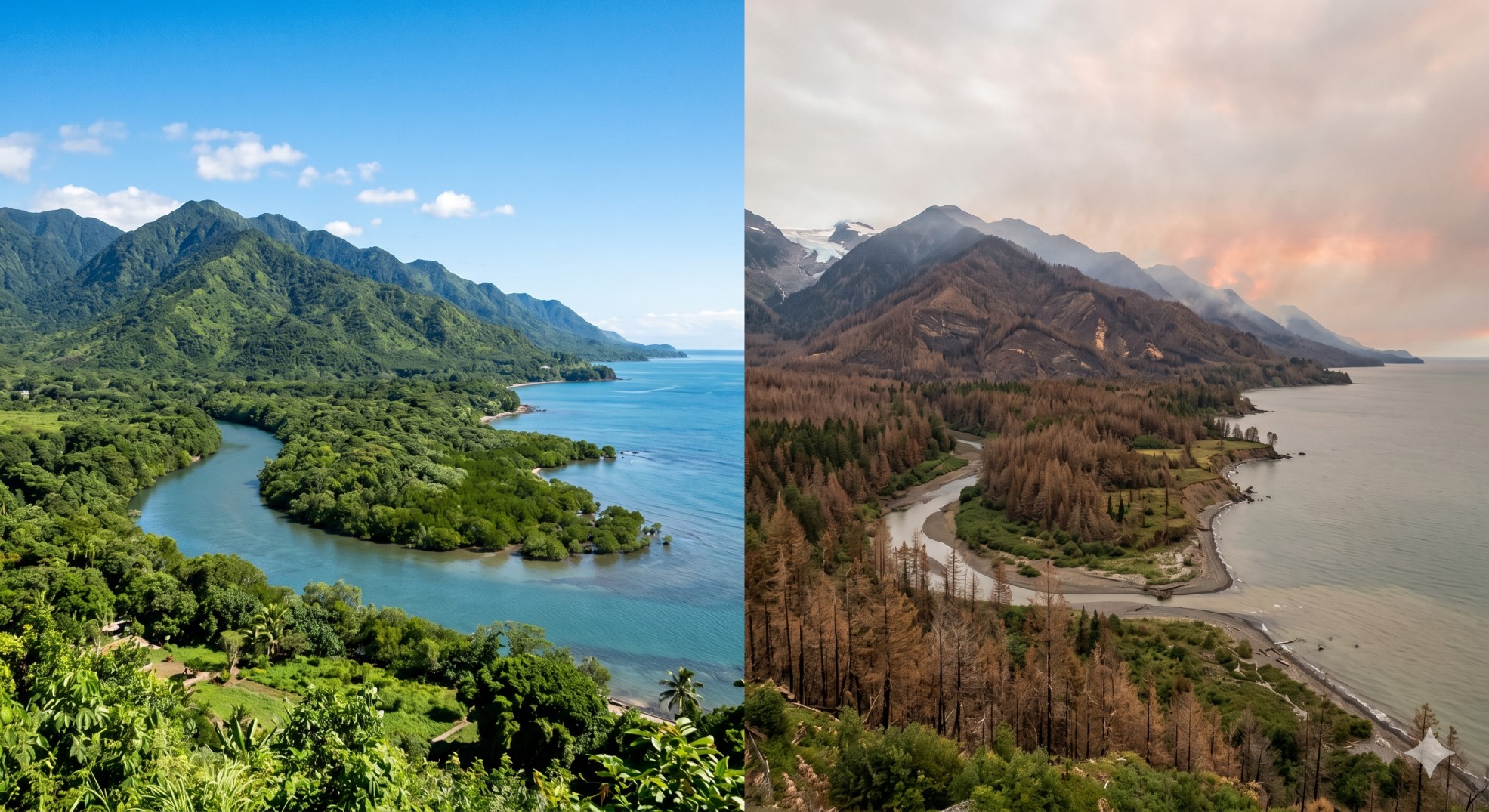
"Earth in Transition: The Story of a Changing Climate"
THE PAST
Step outside today. Does the air feel hotter, drier, or more humid than before? That is weather. Now ask yourself: has your city’s summer grown longer and hotter over the last decade? Have monsoons arrived unpredictably, or have winters turned milder than your parents remember? That long term shift is climate. The difference may seem small, but it changes everything. Weather tells you what to wear today. Climate tells farmers what to grow, city planners where to build, and governments how to protect coasts, water, and food for generations. When climate changes slowly, as it did in Earth’s deep past, ecosystems and societies can adapt. When it changes this fast within decades, not millennia the consequences are not just seasonal. They are existential.
Earth is about 4.5 billion years old, and its climate has never stood still. Long before humans walked the planet, ice ages gripped continents and then retreated in cycles lasting tens of thousands of years. Volcanic eruptions darkened skies for years, asteroid impacts reset ecosystems. The planet has swung between a tropical greenhouse and a near frozen snowball Earth, sometimes within the same era. These natural cycles were driven by predictable forces: subtle shifts in Earth’s orbit and tilt, gradual changes in the Sun’s energy, large volcanic eruptions injecting cooling aerosols, and the slow churning of ocean currents that redistribute heat across hemispheres. These forces operated over thousands to millions of years, giving life time to adapt.
The last great ice age ended roughly 12,000 years ago. Since then, Earth settled into a relatively warm, stable period called the Holocene. This calm window allowed agriculture, cities, trade routes, and written language to emerge. Human civilization flourished within a narrow band of climatic stability that we have now begun to dismantle slowly at first, then at an accelerating pace. Before the Industrial Revolution, atmospheric CO₂ hovered around 280 parts per million. Today, it stands at over 420 ppm, the highest in at least 3 million years. This surge has come in just about 200 years, driven by coal‑powered factories, internal combustion engines, deforestation, and industrial agriculture, each adding invisible layers to an atmospheric blanket that traps far more of the Sun’s heat than in any recorded human history.
Global average temperatures have risen about 1.1–1.2°C above pre industrial levels. That sounds small until you realize the difference between today and the last ice age was only about 4–5°C. We are already a quarter of the way toward a change of ice‑age magnitude, but compressed into centuries, not millennia. Heatwaves that once came once every 50 years now hit every decade. Monsoon systems across South and Southeast Asia, on which billions depend for water and food, are becoming more erratic. Wildfires in Australia, Canada, and Southern Europe have shattered records. The oceans have absorbed about 90% of the excess heat and roughly 30% of our CO₂, turning more acidic and threatening coral reefs and marine life. Sea levels have risen about 20 cm since 1900, and they are rising faster. The Arctic is warming nearly four times as fast as the global average, and glaciers across the Himalayas, Alps, and Andes are retreating at unprecedented rates.
The confusion between weather and climate is not just a technical mix up. It is often used to downplay the crisis. Every cold winter is waved as proof that warming is not real. But climate is not about a single cold day or a single season. It is the long‑term statistical pattern of the atmosphere, and that pattern has unambiguously shifted. Climate change is not a future problem; it is a present reality that farmers, fishers, city planners, insurance companies, and governments are already managing or failing to manage. The biggest barrier is not technology or money. It is perception. People who think climate change will only hit later or isn’t that bad yet are making decisions based on a misreading of where we stand. We are already at 1.2°C of warming, and past emissions have locked in more change. The real question is not whether the climate will change further it will but how much, and whether societies will be shaped by that change or will shape it.

.jpeg)
Donald Trump has again claimed credit for the India-Pakistan ceasefire as part o...
.jpeg)
Fresh U.S. airstrikes in Iran reportedly killed 14 people, prompting Iranian ret...
President Donald Trump claimed he is Iran’s “No. 1 target” after security measur...
.jpeg)
Three people were killed in U.S. strikes in western Iran as tensions escalated f...
President Donald Trump said the Iran ceasefire is “over” following fresh U.S. st...