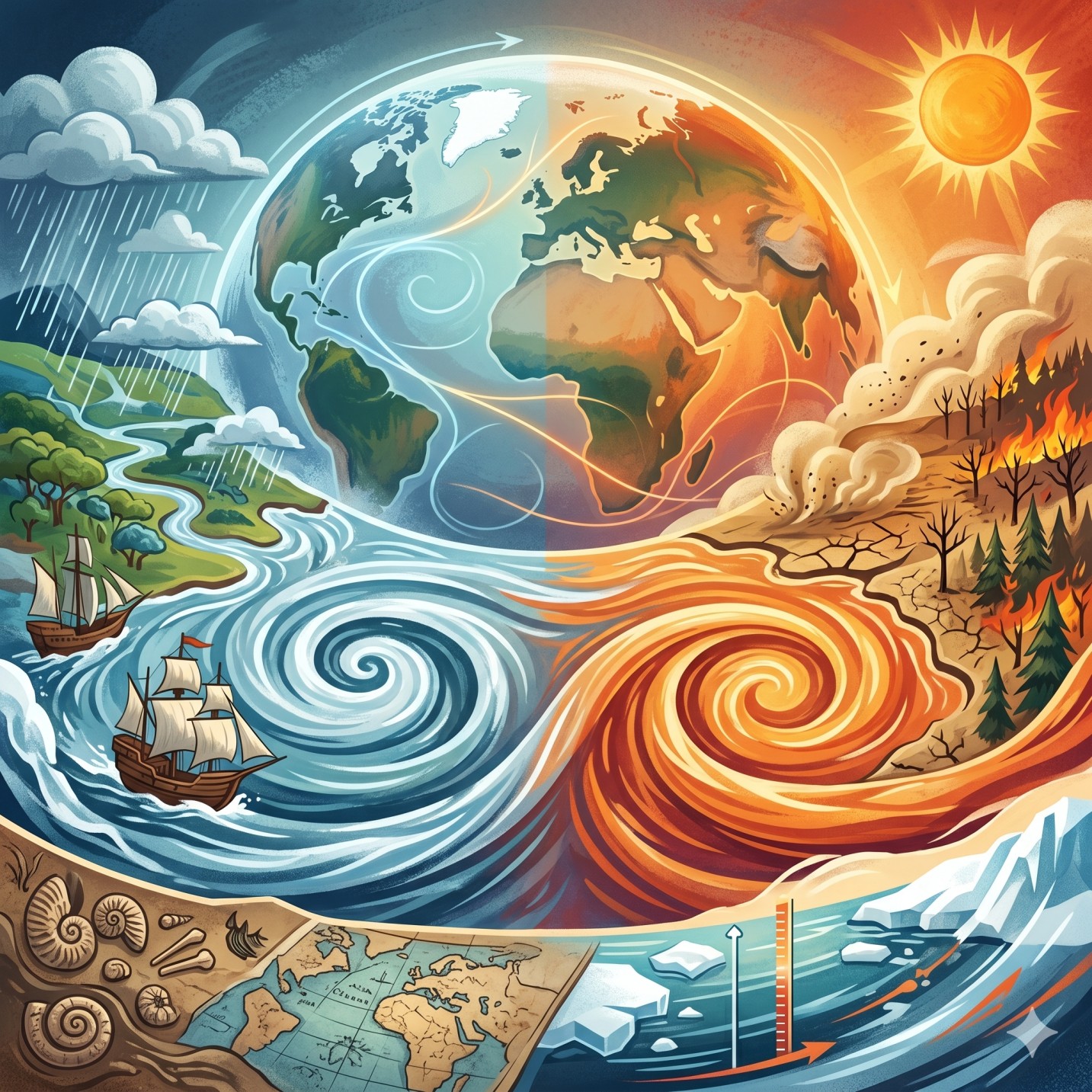
"Earth in Transition: The Story of a Changing Climate"
THE EFFECT
The Ocean Has a Heartbeat
Imagine the Pacific Ocean the largest body of water on Earth, covering more surface area than all the world's landmasses combined slowly inhaling and exhaling. Not water, but heat. Every few years, this ocean redistributes an enormous reservoir of warm water from one side of the planet to the other, and in doing so, rewrites the weather for billions of people across six continents. This is not a metaphor. It is one of the most powerful natural climate cycles operating on Earth today. Scientists call it the El Niño, Southern Oscillation, or ENSO. The world knows its two extremes by their Spanish names El Niño and La Niña given by Peruvian fishermen centuries ago who noticed that every few years, the fish disappeared around Christmas, the sea turned unusually warm, and the rains came where there should have been none. They named the warm phase El Niño, the little boy , or the Christ child, for its habit of arriving near Christmas. The cold phase that often follows became La Niña, the little girl . Together, they represent the ocean-atmosphere system breathing in and out in a rhythm that shapes droughts, floods, famines, and heatwaves across the entire planet.
And in a warming world, that heartbeat is growing dangerously irregular.
When El Niño Strikes
Every two to seven years, something disrupts this balance. The trade winds weaken sometimes dramatically. Without their constant push, the warm water that had been piling up in the western Pacific begins to slosh back eastward, like water tilting in a bathtub when you suddenly stop pushing one end. As this warm water spreads east across the Pacific, it suppresses the cold upwelling along South America's coast. Sea surface temperatures in the central and eastern Pacific rise sometimes by 2°C, sometimes by 4°C or more. In the record breaking El Niño of 1997–98, temperatures in some parts of the eastern Pacific rose by nearly 5°C above normal.
The consequences of this single oceanic shift ripple across the entire planet through the atmosphere:
South America : Peru and Ecuador receive catastrophic rainfall and flooding. The same warm ocean that drives rain eastward devastates the cold-water fish populations that Peruvian fishing communities depend upon.
Australia and Southeast Asia : With the warm pool now shifted eastward, rainfall over Indonesia, the Philippines, and Australia collapses. Severe droughts grip agricultural regions. The risk of wildfires spikes dramatically. The 1997–98 El Niño contributed to catastrophic fires in Indonesia that burned millions of hectares of forest.
India : The Indian monsoon which feeds 1.4 billion people typically weakens during El Niño years. Rainfall arrives late, falls short, or distributes unevenly, threatening crop harvests and reservoir levels across the subcontinent.
East Africa : Parts of Ethiopia, Somalia, and Kenya experience drought. In other El Niño years, the same region floods the pattern is not uniform, but disruption is near certain.
North America : El Niño typically brings a wetter, milder winter to the southern United States and a warmer, drier winter to the Pacific Northwest and Canada. The jet stream shifts, redirecting storm tracks in ways that reshape entire seasons.
The Atlantic hurricane season : El Niño typically suppresses Atlantic hurricane activity by increasing wind shear the variation in wind speed and direction at different altitudes that tears apart forming storms. This is one of El Niño's few reliably beneficial effects for the Caribbean and US East Coast.
La Niña — The Overcorrection
After El Niño peaks, the system often overcorrects. The trade winds return sometimes stronger than before. Warm water is driven back westward with renewed force. Sea surface temperatures in the eastern Pacific drop below normal. This is La Niña, and it tends to produce the opposite effects to El Niño:
Australia and Southeast Asia receive above normal rainfall, sometimes catastrophic flooding
India's monsoon strengthens, often bringing excess rain and flooding
The Atlantic hurricane season becomes more active and more dangerous
Drought grips the southern United States and parts of South America
East Africa, particularly the Horn of Africa, experiences severe multi season drought
La Niña events can last one to three years longer than a typical El Niño. The triple dip La Niña of 2020–2023 was one of the longest on record, contributing to devastating droughts across the Horn of Africa that pushed tens of millions toward famine, and record flooding in Pakistan in 2022 that submerged one third of the country.
A Warmer Baseline Changes Everything
Here is the central problem with ENSO in the 21st century: El Niño and La Niña do not operate in isolation. They operate on top of a baseline ocean temperature that is already elevated by global warming. The oceans have absorbed roughly 90% of the excess heat generated by greenhouse gas emissions since industrialization. The tropical Pacific the engine room of ENSO is measurably warmer than it was even 50 years ago. When El Niño now adds its layer of warming on top of an already warmer ocean, the combined effect is dramatically amplified. The 2023–24 El Niño illustrated this with alarming clarity. It was a strong but not historically unprecedented El Niño in terms of sea surface temperature anomalies. Yet global average temperatures during that event shattered every record in the instrumental record 2023 became the hottest year ever recorded, and 2024 surpassed it. The reason was precisely this stacking effect: a moderately powerful El Niño sitting on top of a ocean and atmosphere already heated by decades of greenhouse gas accumulation.
The Fishermen Were Right
The Peruvian fishermen who first named El Niño understood something that took scientists another century to fully grasp: the ocean and the atmosphere are one system. A change in the sea is a change in the sky. A shift in Pacific temperatures is a shift in Indian monsoons, Australian bushfire seasons, African droughts, and Atlantic hurricanes. What those fishermen could not have imagined is that the system they observed ancient, rhythmic, self contained would one day be operating inside a fundamentally altered ocean. An ocean a degree warmer than it was before industrialization. An ocean absorbing more heat every year. An ocean whose thermal memory is being rewritten by a species that has been burning fossil fuels for less than two centuries. El Niño and La Niña are not the cause of climate change. They are natural rhythms that have shaped civilizations for millennia. But in a warming world, they are becoming amplifiers taking a climate system already pushed off balance and swinging it harder, further, and more unpredictably than at any point in recorded human history.
The ocean is still breathing. The question is whether we will listen to what it is telling us.

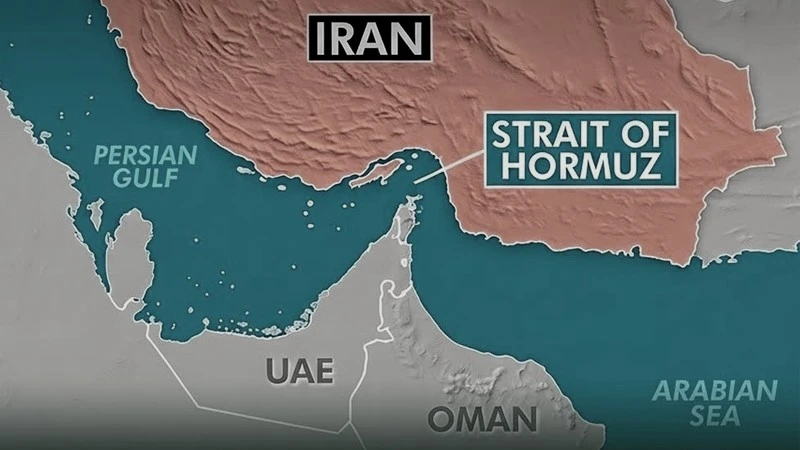
Iran, Oman and the U.S. are reportedly close to a Strait of Hormuz agreement tha...
.jpeg)
Fresh U.S. airstrikes in Iran reportedly killed 14 people, prompting Iranian ret...

President Donald Trump claimed he is Iran’s “No. 1 target” after security measur...
.jpeg)
Three people were killed in U.S. strikes in western Iran as tensions escalated f...

President Donald Trump said the Iran ceasefire is “over” following fresh U.S. st...